
March 7, 2023
Email Marketing will own 2023 - A ValueFirst Perspective
Channel
March 7, 2023

What is an AI Agent?
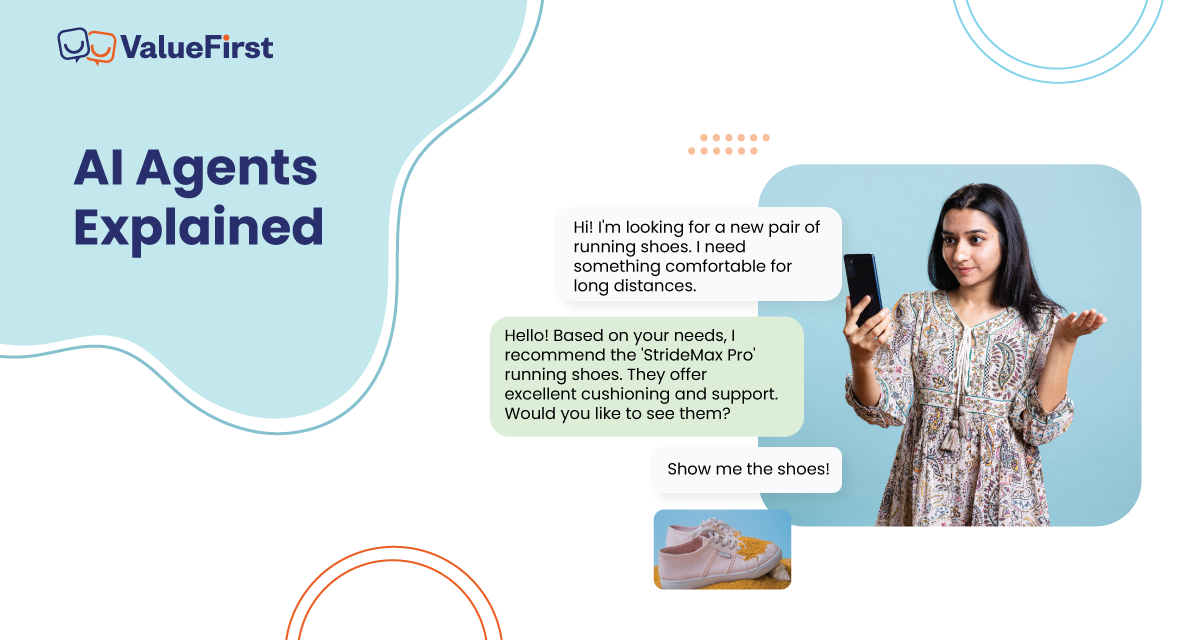
AI agents are intelligent software systems designed to autonomously perform tasks, make decisions, and interact with their environment. Unlike traditional software programs, AI agents are built to reason, learn, and adapt, making them powerful tools for automation and problem-solving. Their intelligence is driven by generative AI models, which allow them to process diverse types of inputs like text, voice, video, and images simultaneously. These agents can collaborate with other agents, handle complex workflows, and even facilitate business transactions.
Key Features of an AI Agent
AI agents have evolved significantly, incorporating various advanced capabilities:
How Do AI Agents Work?
AI agents rely on several core components to function effectively:
Types of AI Agents
AI agents can be categorized based on their function and environment:
1. By Interaction:
2. By Number of Agents:
Benefits of AI Agents
What Are the Different Types of AI Agents?
Organizations design and deploy various AI agents, each tailored for specific tasks. Let’s dive into some key types:
(1) Simple Reflex Agents
Think of these as the “if this, then that” agents. They operate purely on predefined rules and immediate data, reacting only to specific triggers. Their decision-making is limited to a set of event-condition-action rules, making them ideal for straight forward tasks that don’t require extensive learning. For example, a simple reflex agent can detect certain keywords in a user’s message and trigger a password reset—no complex logic, just quick and efficient responses.
(2) Model-Based Reflex Agents
These agents are a step up from simple reflex agents. While they still follow rules, they incorporate a more advanced decision-making framework. Instead of blindly reacting, a model-based agent analyzes its environment, considers possible outcomes, and makes choices based on an internal model of the world. This allows it to handle more dynamic situations rather than just executing predefined commands.
(3) Goal-Based Agents
Goal-based agents, also known as rule-based agents, take things a notch higher by actively working toward a specific objective. Rather than just responding to inputs, they evaluate multiple approaches and select the best one to achieve their goal. This makes them ideal for complex problem-solving tasks such as natural language processing (NLP) and robotics, where they constantly assess and optimize their actions for efficiency.
(4) Utility-Based Agents
These agents go beyond just achieving goals—they strive to maximize outcomes. A utility-based agent evaluates different scenarios based on assigned values or benefits and then selects the one that provides the most rewards. For example, when searching for flight tickets, a utility-based agent can prioritize the shortest travel time, even if it means a higher fare. It’s all about balancing trade-offs to offer the most beneficial result.
(5) Learning Agents
Unlike static agents, learning agents continuously evolve by improving through past experiences. They take in sensory inputs, apply feedback mechanisms, and refine their decision-making over time. With a built-in problem generator, they can create new learning scenarios, using past results to enhance future performance. These agents are particularly useful in adaptive AI systems, where continuous learning is key to improvement.
(6) Hierarchical Agents
Imagine an organized network of AI agents working together in a structured hierarchy. At the top level, high-level agents breakdown complex tasks into smaller, manageable components and assign them to lower-tier agents. Each agent functions independently but reports its progress back to its supervisor. The higher-level agent then compiles these results and ensures seamless coordination across all sub-agents to achieve the collective goal efficiently.
Each type of AI agent serves a unique purpose, from simple rule-following to advanced decision-making and self-learning. Understanding these differences helps organizations choose the right AI framework for their needs.
Use Cases for AI Agents
AI agents are being deployed across industries to enhance productivity and streamline processes:
Next Steps
AI agents are transforming industries by enabling intelligent automation and decision-making. While they come with challenges, their benefits in efficiency, adaptability, and scalability make them an indispensable part of the future of AI-driven operations.


